When customers place an order online, the wait before delivery can feel frustrating and uncertain. If the communication during this time is unclear or impersonal, that feeling only grows. Many shoppers want a personalized and reliable experience that keeps them informed and engaged until their package arrives.
Recent breakthroughs in artificial intelligence are changing the way e-commerce brands connect with customers after purchase. With smarter tools for prediction and communication, you can now provide precise updates, solve delivery problems early, and create meaningful touchpoints that build loyalty. These methods don’t just keep your customers in the loop-they transform standard shipping notifications into opportunities for better engagement and stronger relationships.
Discover proven strategies that harness AI, real-time data, and customer insights to upgrade your post-purchase communication. The next steps will show how you can turn order tracking, delivery management, and follow-up messages into some of your most effective tools for driving satisfaction and repeat business.
Table of Contents
- AI-Driven Predictive Order Status Updates
- Personalized Communication Using Customer Behavior
- Proactive Management of Delivery Issues
- Peak Engagement Window Strategies
- Cross-Selling and Upsell Opportunities Post-Purchase
- Unified Tracking Experiences Across Platforms
- Automated Reputation Management and Review Timing
Quick Summary
| Takeaway | Explanation |
|---|---|
| 1. Invest in AI predictive tracking systems | Using AI-driven order tracking can significantly reduce delivery uncertainty and improve customer satisfaction. |
| 2. Leverage personalized communication for engagement | Tailoring messages based on customer behavior builds loyalty and increases engagement rates directly. |
| 3. Implement proactive management for delivery issues | Anticipating delivery complications can prevent issues before they escalate, saving costs and preserving trust. |
| 4. Utilize the peak engagement window post-purchase | Engaging customers during their waiting period offers a chance to enhance their experience and encourage repeat business. |
| 5. Automate reputation management for better reviews | Timing review requests strategically boosts positive feedback and improves brand reputation effectively. |
1. AI-Driven Predictive Order Status Updates
AI is transforming how online retailers communicate order progress, moving beyond basic tracking to predictive intelligence. Modern e-commerce platforms now leverage sophisticated machine learning algorithms to forecast delivery timelines with unprecedented accuracy.
The core of this revolution lies in AI-powered predictive analytics, which analyze multiple data points to generate hyper-accurate delivery predictions. These systems integrate complex variables like weather conditions, traffic patterns, carrier performance, and historical shipping data to estimate precise arrival times.
Unlike traditional tracking methods that simply relay carrier updates, AI-driven systems provide proactive insights. They can predict potential delays, reroute packages, and automatically adjust customer communications in real time. This approach significantly reduces customer anxiety and improves overall shipping experience.
Retail companies implementing these advanced predictive models see substantial improvements. Studies indicate potential reductions in delivery uncertainty by up to 40%, with customer satisfaction scores increasing correspondingly. The technology essentially transforms shipping from a passive notification process into an intelligent, responsive service.
Key AI Prediction Components:
- Machine learning algorithms
- Real time data processing
- Multivariable analysis
- Automated communication adjustments
Pro tip: Invest in AI predictive tracking systems that offer transparent, personalized delivery forecasts to dramatically enhance customer trust and engagement.
2. Personalized Communication Using Customer Behavior
Personalized communication represents the future of customer engagement in e-commerce, transforming generic interactions into meaningful experiences tailored to individual preferences. Modern retailers are moving beyond traditional communication strategies to create hyper targeted messaging that resonates with each customer.
By leveraging deep learning customer data analysis, online businesses can now decode complex behavioral patterns and anticipate customer needs before they arise. This approach goes far beyond basic demographic segmentation, instead examining nuanced interactions like browsing history, purchase frequency, time spent on product pages, and previous customer service experiences.
The psychological impact of personalized communication cannot be overstated. When customers receive messages that feel specifically crafted for them, they experience a sense of being understood and valued. This emotional connection translates directly into increased brand loyalty, higher engagement rates, and ultimately improved conversion metrics.
Key Elements of Behavioral Personalization:
- Real time data processing
- Predictive customer insights
- Dynamic messaging adaptation
- Contextual communication triggers
Practical Implementation Strategies:
- Integrate advanced analytics platforms
- Create granular customer segments
- Develop adaptive communication workflows
- Use AI to generate contextual messaging
Pro tip: Implement a continuous learning system that refines communication strategies by tracking customer responses and engagement metrics in real time.
3. Proactive Management of Delivery Issues
Proactive delivery management represents a strategic approach to anticipating and resolving shipping challenges before they escalate into customer service nightmares. Modern e-commerce businesses are increasingly leveraging advanced technologies to transform reactive problem solving into predictive issue prevention.
The core of proactive delivery management lies in real-time monitoring and crisis intervention strategies that identify potential disruptions before they impact customer experience. Advanced logistics platforms now use sophisticated algorithms that analyze multiple data points including weather patterns, carrier performance, route conditions, and historical shipping data to predict and mitigate potential delivery complications.
Understanding the economic impact is crucial. Unresolved shipping issues can cost businesses significant revenue through refunds, reshipments, and lost customer trust. Proactive management not only reduces these direct costs but also preserves brand reputation by demonstrating commitment to customer satisfaction.
Key Components of Proactive Delivery Management:
- Predictive analytics
- Real time tracking systems
- Automated issue alerts
- Contingency planning
- Transparent customer communication
Potential Technology Enablers:
- Artificial intelligence
- Internet of Things devices
- Machine learning algorithms
- Advanced logistics platforms
Pro tip: Develop a comprehensive crisis management protocol that includes automated customer communication triggers for potential delivery disruptions.
4. Peak Engagement Window Strategies
The peak engagement window represents the critical time period between a customer placing an order and receiving their purchase where attention and emotional investment are at their highest. Smart e-commerce businesses are now treating this window as a strategic opportunity for deepening customer relationships and driving additional value.
Successful customer retention strategies focus on transforming the traditionally passive shipping experience into an interactive and personalized journey. During this window, customers are most receptive to communication, making it the ideal moment for targeted interactions that enhance their overall brand experience.
The psychological dynamics of the peak engagement window are fascinating. After making a purchase, customers experience a mix of anticipation and curiosity. They are emotionally invested in their order and more likely to interact with brand communications. This presents a unique opportunity to provide value beyond simple shipping updates.
Strategic Engagement Window Components:
- Real time order tracking
- Personalized updates
- Interactive communication channels
- Value added content delivery
- Emotional connection building
Potential Engagement Tactics:
- Recommend complementary products
- Share product care instructions
- Offer exclusive post purchase discounts
- Provide behind the scenes brand stories
- Request feedback at optimal moments
Pro tip: Design a dynamic communication workflow that adapts messaging based on individual customer preferences and past interaction patterns.
5. Cross-Selling and Upsell Opportunities Post-Purchase
Post-purchase marketing represents a golden opportunity for e-commerce businesses to maximize customer value and drive additional revenue through strategic cross-selling and upselling techniques. The moments immediately following a customer purchase are psychologically primed for introducing complementary products and upgrades.
Digital marketing strategies now leverage advanced predictive analytics to recommend products with surgical precision. By analyzing purchase history, browsing behavior, and customer profiles, businesses can craft personalized offers that feel genuinely helpful rather than intrusive.
The science behind successful post-purchase recommendations involves understanding customer intent and anticipating their next potential need. Advanced algorithms can identify logical product pairings that enhance the original purchase or solve adjacent problems the customer might encounter.
Key Cross-Selling Strategies:
- Analyze past purchase patterns
- Create logical product recommendations
- Use contextual relevance
- Time offers strategically
- Provide clear value proposition
Upsell Implementation Techniques:
- Bundle complementary products
- Offer tiered upgrade options
- Demonstrate incremental value
- Use social proof
- Create time sensitive offers
Pro tip: Design post-purchase recommendation algorithms that prioritize customer utility over pure sales conversion, ensuring recommendations feel genuinely helpful.
6. Unified Tracking Experiences Across Platforms
Unified tracking experiences represent the next frontier of customer communication in e-commerce, bridging fragmented digital interactions into a seamless, intuitive journey. Modern consumers expect consistent and integrated tracking regardless of the platform or device they use.
Advanced AI-driven customer experience technologies now enable retailers to create holistic tracking environments that transcend individual platform limitations. These intelligent systems harmonize data from multiple sources, providing customers with real-time, consistent updates across mobile apps, websites, social media channels, and physical retail touchpoints.
The core challenge lies in creating a unified data infrastructure that can translate complex shipping information into user friendly formats. Sophisticated algorithms now parse carrier data, internal logistics systems, and customer interaction history to generate comprehensive tracking experiences that feel personalized and transparent.
Key Unified Tracking Components:
- Cross platform data integration
- Real time synchronization
- Adaptive user interfaces
- Personalized communication protocols
- Multichannel tracking consistency
Strategic Implementation Approaches:
- Develop universal tracking APIs
- Standardize data communication formats
- Create device agnostic tracking interfaces
- Implement intelligent routing mechanisms
- Enable seamless data transfer between platforms
Pro tip: Invest in middleware technologies that can abstract and normalize tracking data across different carrier and platform ecosystems.
7. Automated Reputation Management and Review Timing
Automated reputation management represents a sophisticated approach to proactively protecting and enhancing a brand’s online perception through intelligent technological interventions. Modern e-commerce businesses are moving beyond reactive review monitoring to predictive reputation strategies.
By leveraging advanced artificial intelligence techniques, companies can now analyze sentiment, track customer feedback, and strategically time review requests to maximize positive outcomes. The technology goes far beyond simple review collection, integrating complex contextual analysis to determine the optimal moment for soliciting customer feedback.
The psychological nuances of review timing are critical. Requesting reviews too early or too late can significantly impact response rates and sentiment. Intelligent systems now evaluate multiple variables including delivery experience, product interaction duration, and individual customer satisfaction signals to determine the precise window for review generation.
Strategic Reputation Management Components:
- Real time sentiment tracking
- Contextual feedback analysis
- Adaptive review request timing
- Automated response generation
- Predictive satisfaction modeling
Reputation Protection Techniques:
- Monitor multiple review platforms
- Analyze customer interaction signals
- Create dynamic feedback workflows
- Implement intelligent filtering mechanisms
- Use machine learning for sentiment prediction
Pro tip: Develop a multilayered reputation management strategy that uses AI to not just collect reviews, but to understand the deeper contextual signals behind customer experiences.
Below is a comprehensive table summarizing the advancements and applications of AI-driven techniques in the e-commerce and retail sectors as discussed in the article.
| Aspect | Description | Advantages |
|---|---|---|
| AI-Powered Predictive Order Status Updates | Utilizing machine learning algorithms to forecast delivery timelines and predict delays or rerouting. | Increased customer satisfaction through improved delivery accuracy. |
| Personalized Communication | Leveraging customer behavior analysis for targeted and meaningful interactions. | Enhanced engagement rates and customer loyalty. |
| Proactive Delivery Management | Employing predictive strategies to preempt shipping issues, ensuring smoother logistics. | Reduced costs and elevated brand trust. |
| Peak Engagement Strategies | Maximizing communication and interactions during the critical post-purchase period. | Strengthened customer relationships and additional value creation. |
| Post-Purchase Marketing | Using analytics to recommend complementary or upgraded products. | Increased revenue through effective cross-selling and upselling techniques. |
| Unified Tracking Experience | Harmonizing tracking information across platforms for a seamless user experience. | Boosted customer convenience and satisfaction. |
| Automated Reputation Management | Employing AI for timing review solicitations and monitoring brand sentiment. | Improved brand image and customer reliability. |
Transform Your Ecommerce Post-Purchase Journey with WISMOlabs
The article “7 Order Tracking Trends for Ecommerce in 2026” highlights key challenges such as reducing customer anxiety during order tracking, delivering personalized communication, and effectively managing the peak engagement window between purchase and delivery. Retailers face the pain of repetitive notifications and fragmented shipping experiences that damage brand loyalty and hurt revenue growth. Concepts like AI-driven predictive updates, proactive delivery management, and unified tracking resonate deeply with WISMOlabs’ intelligent post-purchase orchestration platform.
WISMOlabs takes these trends further by treating the post-purchase experience as a strategic “Decision Layer” that goes beyond standard messaging. Its proprietary AI analyzes shipment context, customer profiles, and behavior to deliver high-value, branded updates exactly when customers most need them. This sharp focus reduces “Where Is My Order?” tickets by up to 90% while driving revenue via personalized upsells and cross-sells during the high-attention Peak Engagement Window™. If you want to seamlessly unify tracking, personalize communication, and proactively prevent delivery issues, discover how WISMOlabs transforms order tracking.
Ready to turn the challenges of modern ecommerce order tracking into a competitive advantage?
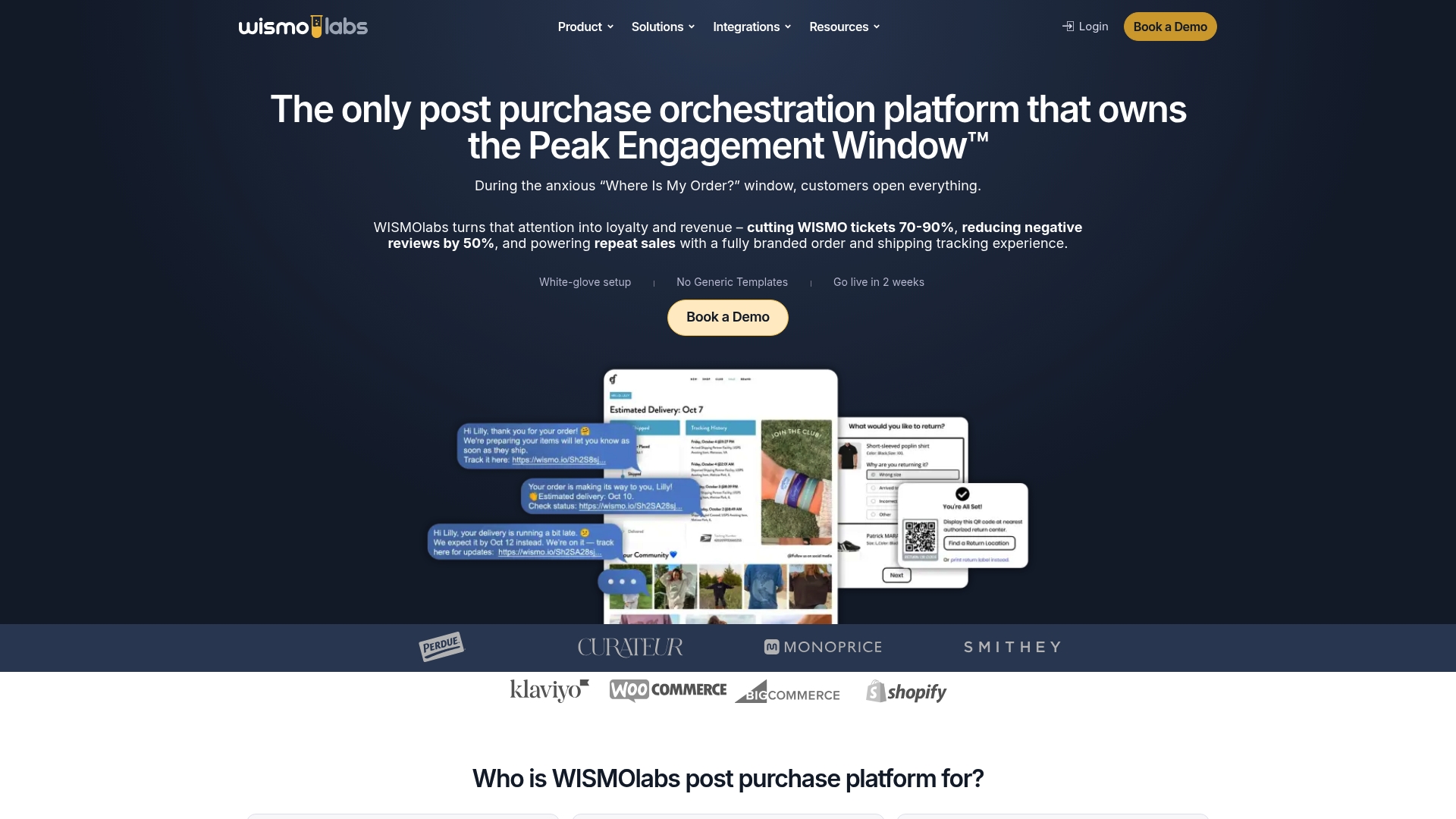
Experience how WISMOlabs’ AI-driven platform empowers your brand to reduce negative reviews, increase customer trust, and unlock new revenue streams. Take the next step today to learn more about intelligent post-purchase orchestration on the WISMOlabs homepage and start transforming your ecommerce order tracking now.
Frequently Asked Questions
What are AI-driven predictive order status updates in e-commerce?
AI-driven predictive order status updates utilize machine learning algorithms to forecast delivery timelines with high accuracy. To implement this, consider investing in AI predictive tracking systems that analyze data from multiple sources to enhance customer communication.
How can personalized communication improve customer engagement during order tracking?
Personalized communication tailors messages to individual preferences based on customer behavior data. Start by integrating advanced analytics to create targeted messaging that enhances customer experience and increases brand loyalty.
What strategies can help manage delivery issues proactively in e-commerce?
Proactive delivery management involves using real-time monitoring to anticipate shipping disruptions before they affect customers. Develop a crisis management plan that includes automated alerts and transparent customer communication to keep customers informed.
How can e-commerce businesses optimize the peak engagement window after a purchase?
The peak engagement window is the time when customers are most emotionally invested in their orders. Use this opportunity to deliver personalized updates and value-added content that enhances the overall customer experience immediately following a purchase.
What techniques can be used for effective cross-selling and upselling after customers make a purchase?
Effective cross-selling and upselling involve analyzing purchase patterns and recommending complementary products. Design algorithms to provide relevant recommendations shortly after a purchase to maximize customer value and increase average order value.
How do unified tracking experiences benefit customers and e-commerce businesses?
Unified tracking experiences create a seamless journey for customers by providing consistent updates across all platforms. To achieve this, invest in integrating tracking data from various sources to ensure customers receive real-time, accurate information regardless of the device they use.
Recommended
- Real-Time Shipment Tracking Tools for 2025 – WISMOlabs
- Revolutionize Your Business with AI-Powered E-commerce Tracking – WISMOlabs
- Improve Post-Purchase Customer Experience | Order Tracking & WISMO Reduction
- Study Shows Consumers Are Addicted to Tracking Pages
- Boost Your Success with Customer Engagement in Retail | BonusQR