Keeping customers informed after checkout often feels overwhelming for mid-sized online retailers in North America. When buyers wonder where their package is, support teams scramble to respond quickly or risk damaging trust. That’s where automated systems and AI-driven technologies transform the post-purchase experience, turning routine updates into valuable touchpoints. Discover how purposeful automation not only reduces WISMO inquiries but builds lasting loyalty-without drowning customers in unnecessary notifications.
Table of Contents
- Defining Post-Purchase Automation In Ecommerce
- Types Of Post-Purchase Automation Flows
- Core Features And AI-Driven Strategies
- Real-World Applications And Growth Impact
- Risks, Costs, And Implementation Mistakes
- Comparing Alternatives And Best Practices
Key Takeaways
| Point | Details |
|---|---|
| Post-Purchase Automation Enhances Engagement | Implementing automated systems fosters timely and personalized communication, creating a stronger relationship with customers immediately after purchase. |
| Data-Driven Decision Making is Essential | Utilizing AI to analyze customer behavior and history improves the effectiveness of post-purchase messages and reduces irrelevant communications. |
| Focus on Customer Experience and Revenue | Post-purchase interactions should be viewed as opportunities for revenue generation, enhancing customer loyalty through relevant recommendations and incentives. |
| Careful Implementation Avoids Common Pitfalls | Avoid over-automation by maintaining a balance between personalized communication and efficient automation to prevent customer dissatisfaction. |
Defining post-purchase automation in ecommerce
Post-purchase automation in ecommerce refers to the use of automated systems and AI-driven technologies to engage customers after their purchase is complete. Rather than treating the post-purchase experience as a single transaction, this approach recognizes it as an ongoing relationship where strategic communication, personalized follow-ups, and timely interactions create measurable business value. For mid-sized online retailers, this distinction is critical: the period immediately following a customer’s purchase represents a window of peak attention and engagement where the right message at the right moment can dramatically shift customer sentiment, loyalty, and lifetime value.
The core of post-purchase automation involves timely follow-ups and personalized communication that would be impossible to manage at scale through manual processes. Think of it this way: without automation, your team would need to send individual tracking updates, shipping confirmations, and delivery notifications to hundreds or thousands of customers daily. That’s not just inefficient-it’s practically impossible. Automation handles this at velocity while maintaining the personal touch that customers expect. The system monitors carrier data, evaluates real-time shipment context, and determines when and how to communicate based on what’s actually happening with each order, not just generic timelines.
What distinguishes effective post-purchase automation from basic email workflows is the intelligent decision-making layer that sits beneath the surface. Rather than simply reacting to carrier updates or following a predetermined calendar, truly sophisticated automation evaluates multiple data points: the customer’s purchase history, their previous engagement patterns, their order specifics, and the current status of their shipment. Research shows that automated processes enhance convenience while requiring thoughtful design to avoid undermining customer loyalty through excessive or tone-deaf messaging. This is where many retailers stumble. They automate without thinking, flooding customers with redundant notifications that breed anxiety instead of confidence. The difference between good automation and bad automation often comes down to whether the system asks the right questions before sending each message: Does this customer actually need to hear from us right now? Will this message add value or trigger frustration?
For your business specifically, this means moving beyond treating post-purchase as a cost center focused on reducing support tickets. When structured correctly, the post-purchase window becomes a revenue-generation opportunity. Customers in this phase are primed to engage with your brand-they’re thinking about their purchase, anticipating delivery, and open to relevant product recommendations or loyalty offers. Automation that respects this attention span while capitalizing on it can drive substantial improvements in customer experience and business outcomes.
Pro tip: Start by auditing your current post-purchase touchpoints: track how many messages each customer receives from order placement to delivery, then identify which ones actually provide value versus which ones create noise. This baseline reveals where automation can make the biggest impact on reducing WISMO inquiries while strengthening customer trust.
Types of post-purchase automation flows
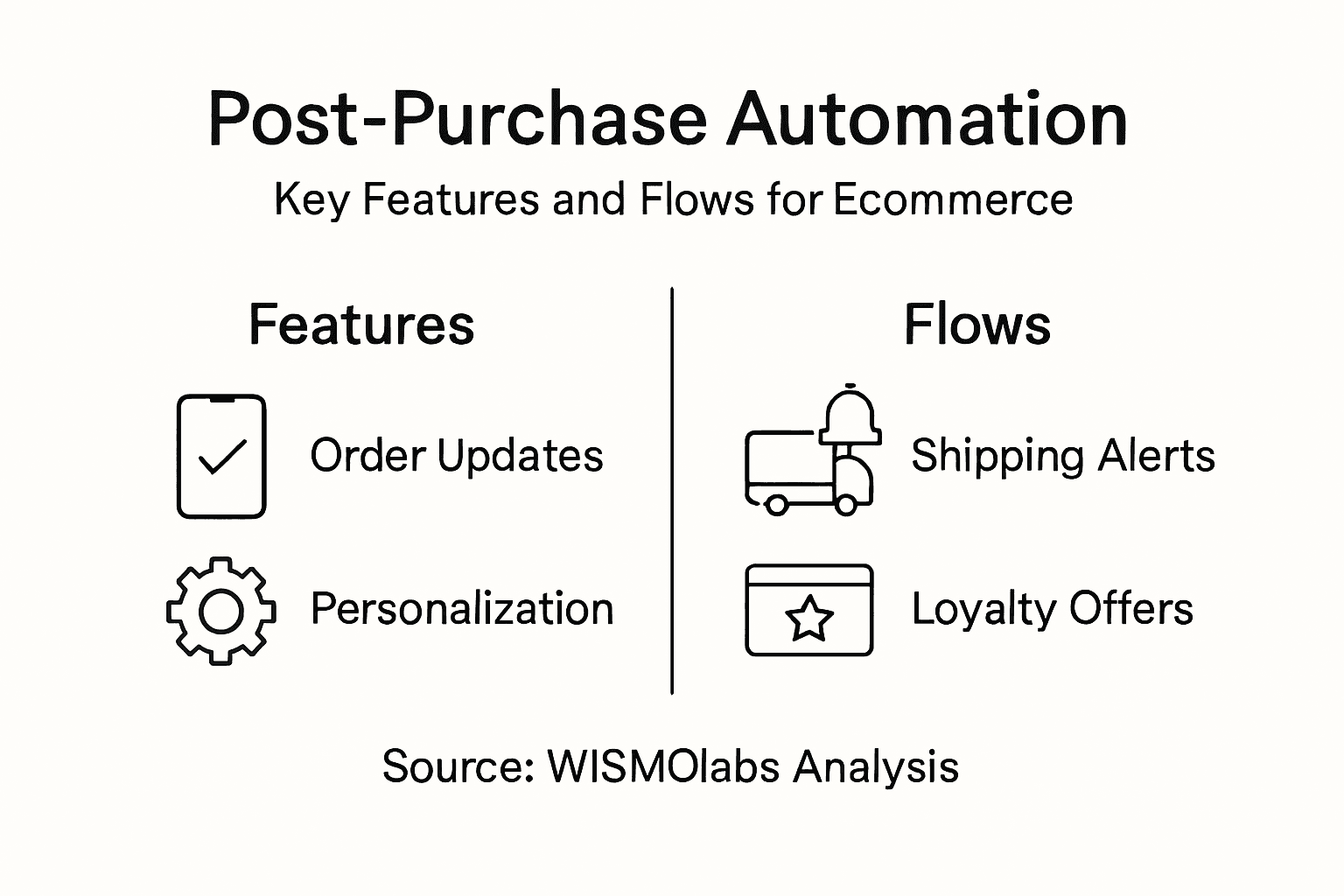
Post-purchase automation flows are the specific sequences of messages and actions your system triggers at particular moments during the customer journey after purchase. Rather than one-off communications, these flows are orchestrated sequences that guide customers through their post-purchase experience while simultaneously building brand loyalty and creating revenue opportunities. For mid-sized retailers, understanding the different types of flows available is the first step toward building an automation strategy that actually works.
The most common post-purchase automation flows include order confirmation and shipping updates, which form the backbone of any post-purchase system. These flows reassure customers that their purchase was processed and keep them informed about delivery progress. Beyond basic tracking notifications, effective flows integrate timely follow-ups that maintain engagement without overwhelming customers with redundant alerts. Then come personalized recommendation flows, which leverage customer data and purchase history to suggest complementary products during the peak attention window when customers are actively thinking about their order. Review request flows and feedback collection round out the engagement layer, gathering valuable social proof and customer insights that inform product development and marketing. What ties these together is that AI-driven systems optimize timing and messaging to ensure each touchpoint adds value rather than creating noise.
Beyond engagement-focused flows, your automation strategy should include retention and loyalty flows that prevent churn and encourage repeat purchases. These flows use machine learning to identify at-risk customers and trigger targeted win-back campaigns with relevant incentives or content. Return and exchange flows automate the handling of customer issues, reducing friction when things go wrong and transforming a potential negative experience into a service recovery opportunity. Abandoned cart recovery flows capture missed sales by reminding customers about items they left behind, while repeat purchase flows use purchase history patterns to resurface products when customers are likely to need them again. The key differentiator among high-performing retailers is that retention strategies leverage data-driven insights to identify which customers are most likely to churn and which are primed for upsell opportunities.
When building your flows, think about the customer lifecycle stage each one serves. Early flows focus on reassurance and engagement, middle flows focus on building loyalty and capturing additional revenue, and later flows focus on retention and reactivation. The flows that drive the most impact tend to be those that serve a specific business objective while simultaneously solving a customer problem. An effective shipping update flow, for example, reduces support tickets by answering questions before customers ask them while creating a branded touchpoint that reinforces your company’s professionalism.
For reference, here is a summary of common post-purchase automation flows and their primary business benefits:
| Automation Flow | Main Purpose | Key Benefit |
|---|---|---|
| Shipping Updates | Inform about delivery status | Reduces support tickets |
| Product Recommendations | Suggest complementary items | Drives cross-sell revenue |
| Review Requests | Gather customer feedback | Boosts social proof |
| Loyalty Offers | Reward repeat buyers | Increases retention rate |
| Return/Exchange Handling | Streamline issue resolution | Improves satisfaction, reduces churn |
Pro tip: Start by mapping out the customer journey from purchase to 90 days post-delivery, then identify which flows you currently have in place and which critical gaps exist. Prioritize implementing flows that address your highest WISMO inquiry volume first, as these typically deliver the fastest ROI.
Core features and AI-driven strategies
Effective post-purchase automation hinges on a combination of intelligent features that work together to transform transactional moments into strategic touchpoints. The most powerful post-purchase systems share core capabilities that distinguish them from basic email tools. These include real-time shipment tracking integration, which pulls live carrier data and converts raw tracking information into human-readable updates that customers actually want to read. Then there’s personalized communication, which uses customer purchase history and behavior to tailor messaging tone, timing, and content for each individual. Predictive analytics for anticipating customer needs allow your system to determine not just what to send, but when the customer is most likely to engage with it. Finally, automated customer service via chatbots handles routine inquiries without requiring human intervention, freeing your support team to focus on complex issues while reducing WISMO ticket volume.

What separates winning retailers from the rest is how they leverage AI within these core features. Rather than treating AI as a checkbox feature, high-performing brands use deep learning algorithms for targeted product recommendations that feel genuinely relevant during the post-purchase window. This means the system analyzes patterns across thousands of similar customers to surface products that complement what was just purchased, rather than pushing generic bestsellers. AI-driven systems also employ real-time data processing to make split-second decisions about whether to send a message right now or hold it for a better moment. For example, if a shipment is delayed, the AI recognizes this and automatically suppresses promotional content while instead surfacing empathetic, solution-focused messaging. This contextual awareness is what prevents customers from feeling bombarded with irrelevant communication.
Another critical AI strategy involves behavioral prediction and churn prevention. The system continuously evaluates customer signals like engagement rates, purchase frequency, and support ticket sentiment to identify who is at risk of not returning. When the AI detects churn indicators, it can automatically trigger retention campaigns with personalized incentives designed to re-engage that specific customer segment. This moves post-purchase automation from reactive customer service into proactive business protection. Additionally, AI-powered engagement through personalized experiences ensures that each customer receives communications that feel tailored to their preferences and stage in the customer lifecycle rather than following a one-size-fits-all calendar.
The infrastructure beneath these features matters just as much as the features themselves. Sophisticated systems use machine learning to continuously refine their decision logic based on outcomes. When one customer segment responds better to shipping updates on Wednesdays versus Thursdays, the system learns this preference and adapts. When emoji-heavy messaging drives higher engagement for younger demographics but lower engagement for older segments, the system captures this insight and personalizes accordingly. This continuous learning transforms static automation into a system that improves with every message sent.
Pro tip: When evaluating post-purchase automation platforms, ask specifically how the system handles conflicting data points: if a customer has high engagement but also filed a delivery complaint, does it suppress promotional content and prioritize support messaging instead? This decision-making intelligence is what separates platforms that reduce WISMO from those that accidentally amplify frustration.
Real-world applications and growth impact
Post-purchase automation moves from theoretical benefit to concrete business value when you look at how mid-sized retailers are actually deploying it. One of the most immediate applications is automated feedback and review collection, which captures customer opinions at the moment of peak satisfaction while their experience is fresh. Rather than hoping customers will leave reviews weeks later, automation prompts them at the optimal time, dramatically increasing review volume and quality. Paired with this is loyalty program management, which automatically enrolls customers in rewards programs, tracks earned points, and sends timely notifications about available benefits. What makes this particularly powerful is that personalized marketing automation drives measurable revenue growth by presenting loyalty rewards and offers that match individual customer preferences rather than blasting generic promotions to your entire list. Another application gaining traction is remote product access and digital asset delivery, which gives customers immediate value after purchase by providing downloadable guides, tutorials, or exclusive content. This creates multiple touchpoints that keep customers engaged while positioning your brand as genuinely invested in their success.
The growth impact of these applications shows up clearly in the metrics that matter to retailers. Companies deploying post-purchase automation report significantly improved repeat purchase rates, with returning customers often cited as 25 to 40 percent more valuable than first-time buyers. When automation nurtures these relationships systematically, the compounding effect accelerates revenue growth. Beyond repeat purchases, loyalty program management and customer engagement foster stronger emotional connections to brands, moving customers from transactional relationships into genuine brand advocates. Consider the practical math: if your average order value is 75 dollars and you increase repeat purchase rates by just 20 percent through effective post-purchase nurturing, a retailer processing 1,000 orders monthly gains an additional 15,000 dollars in monthly revenue. Over a year, that’s 180,000 dollars from a single metric improvement.
Mid-sized retailers are also seeing dramatic improvements in customer service efficiency and cost reduction. Automated responses to common post-purchase questions reduce support ticket volume by 50 to 70 percent, freeing your team to handle complex issues that actually require human judgment. This translates directly to lower support costs while paradoxically improving customer satisfaction because simple questions get answered instantly rather than waiting in a queue. Additionally, real-time shipment tracking eliminates the majority of “where is my order” inquiries entirely, further reducing support burden. The competitive advantage here is substantial: retailers who master post-purchase automation gain operational efficiency that competitors without these systems simply cannot match.
The revenue multiplication effect becomes even more apparent when you layer in cross-sell and upsell opportunities. Automation identifies which customers are most likely to purchase complementary products based on their initial order and behavioral signals, then presents these recommendations at moments when customers are most receptive. Unlike generic “customers who bought this also bought that” suggestions, AI-driven recommendations feel personalized because they are. This drives incremental revenue from the existing customer base without increasing marketing spend proportionally.
Pro tip: Start tracking your repeat purchase rate, average customer lifetime value, and support ticket volume for the next 30 days as baseline metrics. Once you implement post-purchase automation, measure these same metrics again after 90 days to quantify your actual ROI rather than relying on industry benchmarks that may not apply to your specific business.
Risks, costs, and implementation mistakes
Post-purchase automation delivers impressive returns when executed thoughtfully, but poor implementation can backfire spectacularly. The most fundamental risk is what research calls over-automation without personalization, where retailers flood customers with irrelevant messages that feel invasive rather than helpful. When your system sends the same shipping update to every customer regardless of their preferences or communication history, you undermine the psychological sense of ownership and control that customers value. Over-automation without personalization undermines customer loyalty by making interactions feel robotic and impersonal at the exact moment when customers are most receptive to building emotional connections with your brand. A customer who receives five redundant tracking notifications across email, SMS, and push notifications doesn’t feel cared for; they feel tracked. This is the narrow line between automation that delights and automation that alienates.
Another critical mistake is neglecting data privacy and transparency in AI-driven personalization. When your system collects behavioral data to inform recommendations, customers deserve clarity about what data you’re using and why. Many retailers make the error of deploying AI recommendations without explaining how the system works or giving customers meaningful control over their preferences. Poor ethical handling of AI and data privacy violations damage customer trust far more quickly than they build it, and rebuilding that trust takes significantly longer. If a customer discovers that your system is using their browsing history to push personalized offers without their knowledge, they may not just unsubscribe from emails; they may leave negative reviews and avoid your brand entirely. Transparency costs nothing and prevents this damage.
On the cost side, retailers underestimate both the upfront investment and the ongoing resource requirements. Implementation typically involves platform licensing, integration with existing systems, data migration, and staff training. Many mid-sized retailers expect these investments to pay off within three months, then become frustrated when results take longer to materialize. The mistake is treating post-purchase automation as a plug-and-play solution rather than a strategic capability that requires continuous optimization. You cannot set up automated flows and ignore them; the system requires regular analysis, A/B testing, and refinement based on performance data. Additionally, poor data quality creates cascading problems. If your customer database contains incomplete or inaccurate information, your personalization attempts will miss the mark, and customers will receive irrelevant recommendations that damage your credibility.
Common implementation errors also include starting too broadly. Retailers sometimes attempt to automate everything simultaneously, creating overwhelming complexity that dilutes effectiveness. The smarter approach is to start with your highest-impact flows (those addressing the most common support questions), prove ROI, then expand systematically. Another mistake is failing to integrate post-purchase automation with your broader customer data strategy. If your automation system cannot access real-time inventory data, it might recommend out-of-stock products. If it cannot connect with your CRM, it might send welcome offers to customers who already purchased.
Pro tip: Before implementing any automation, audit your data quality and conduct a customer privacy impact assessment. Ask: Do we have reliable customer preference data? Can we explain why this recommendation appears to this specific customer? If you cannot answer yes to both questions, your automation will likely backfire. Fix these foundation issues first, then implement automation.
Comparing alternatives and best practices
When evaluating post-purchase automation solutions, you essentially face a spectrum of approaches ranging from basic to sophisticated. On one end sit simple notification systems, which send predetermined messages on fixed schedules. A customer places an order on Monday, receives a confirmation email that day, a shipping notification when the carrier picks up the package, and a delivery confirmation when it arrives. These systems are inexpensive and require minimal setup, but they treat all customers identically and cannot adapt to individual preferences or real-time circumstances. On the opposite end sit comprehensive AI-driven platforms that evaluate carrier data, customer history, behavioral signals, and dozens of other variables to determine if, when, and how to communicate. Between these extremes exist hybrid approaches that blend automation with manual elements, requiring staff to review and approve certain communications before they reach customers.
The critical distinction between alternatives comes down to adaptability and personalization capability. Basic alternatives lack the adaptive learning that AI-driven systems provide, meaning they cannot improve over time based on customer response patterns. If your system sends review requests to all customers regardless of delivery status, non-AI alternatives have no mechanism to recognize that this approach generates complaints and adjust accordingly. Conversely, intelligent systems continuously analyze which customer segments respond to review requests, which prefer SMS over email, and which value review requests not at all. The tradeoff is that sophisticated systems cost more upfront and require more sophisticated data infrastructure. Yet the ROI typically justifies this investment for mid-sized retailers processing enough orders to generate statistically significant performance data.
Here’s a quick comparison of basic vs. AI-driven post-purchase automation systems:
| Criteria | Basic Notification System | AI-Driven Automation Platform |
|---|---|---|
| Personalization | Generic, no individual customization | Highly tailored to customer behavior |
| Adaptability | Static, fixed schedule | Dynamically adapts in real-time |
| Data Usage | Limited (simple status updates) | Leverages order history and engagement |
| Business Impact | Reduces support for basic needs | Enhances loyalty and drives revenue |
| Cost | Low, minimal investment | Higher, requires tech investment |
Best practices in post-purchase automation emphasize several key principles. First, deploy systems with deep learning recommendation capabilities that go beyond basic collaborative filtering to understand individual customer context. Second, maintain transparency about how your AI works. When you recommend a product, customers should understand why it appeared to them. Third, integrate human oversight into critical decisions. Not every communication should be fully automated; human judgment adds nuance and prevents tone-deaf moments. Fourth, practice continuous testing and iteration. The best-performing flows are those that have been tested repeatedly, analyzed for results, and refined based on findings. Fifth, respect customer control and preferences by offering meaningful ways for customers to adjust notification frequency, communication channels, and types of offers they want to receive.
The practical best practice for most mid-sized retailers is to implement a tiered automation strategy. Start with automating low-risk, high-volume flows like order confirmations and shipping updates using intelligent systems that adapt based on delivery status. Layer in personalized recommendations only when you have sufficient data quality and customer segmentation to make them genuinely relevant. Reserve high-touch communications like proactive service recovery or VIP customer outreach for human review before sending. This balanced approach captures efficiency gains from automation while maintaining the personal judgment that builds lasting customer relationships. The retailers seeing the strongest results combine smart automation with strategic human involvement, not treating these as competing approaches but as complementary strengths.
Pro tip: When evaluating post-purchase automation platforms, request a trial period focused specifically on your highest-WISMO flow (whether that’s tracking updates, delivery confirmations, or return inquiries). Measure the baseline support ticket reduction after 30 days of automation before committing to a longer contract, as this real-world data matters far more than vendor promises.
Unlock the Full Potential of Post-Purchase Automation with WISMOlabs
The challenge many mid-sized ecommerce retailers face is transforming post-purchase communications from generic, overwhelming alerts into thoughtful, personalized interactions that build loyalty and boost revenue. This article highlights common pain points such as excessive notifications that increase customer anxiety, ineffective handling of “Where Is My Order” questions, and missed opportunities during the peak engagement window. WISMOlabs addresses these concerns by acting as an intelligent decision layer that evaluates real-time shipment context, customer profiles, and behavioral signals to ensure every message adds true value.
Experience automation that respects your customers with AI-driven features like hyper-accurate ETAs, Reputation Guard logic that suppresses review requests after delivery issues, and seamless orchestration of upsells and cross-sells when customers are most receptive. This sophisticated approach not only reduces WISMO tickets by up to 90 percent and cuts negative reviews in half but also turns the post-purchase phase into a strategic growth engine. Discover how you can harness personalized, proactive communication to build trust and increase lifetime customer value by exploring WISMOlabs’ intelligent post-purchase orchestration platform.
Take control of your post-purchase experience now and watch your support tickets decrease while customer satisfaction and revenue soar.
Ready to transform post-purchase automation from a business cost to a revenue driver Visit WISMOlabs today and see how our platform can get you live in under two weeks with a white-glove setup. Harness AI-powered decision making to deliver the right message at the right time and start maximizing your Peak Engagement Window™ immediately.
Frequently Asked Questions
What is post-purchase automation in ecommerce?
Post-purchase automation in ecommerce refers to automated systems and AI-driven technologies that engage customers after they complete a purchase, transforming the post-purchase experience into an ongoing relationship with strategic communication and personalized follow-ups.
How can post-purchase automation boost customer loyalty?
Post-purchase automation enhances customer loyalty by maintaining timely and personalized communication that makes customers feel valued. By engaging with them in the moments following their purchase, brands can build emotional connections and provide offers that encourage repeat purchases.
What types of post-purchase automation flows are most effective?
Common post-purchase automation flows include order confirmation and shipping updates, personalized product recommendations, review requests, and loyalty offers. Each flow is designed to enhance customer engagement and support while also increasing revenue opportunities.
What are the risks associated with poor post-purchase automation implementation?
The main risks include over-automation without personalization, leading to irrelevant messages that frustrate customers, and neglecting data privacy, which can erode trust. Mismanagement can also result in increased support tickets and customer dissatisfaction due to poor execution of automated communications.