Nearly 67 percent of repeat customers generate more value than one-time buyers, highlighting the financial power of smart post-purchase engagement for American ecommerce brands. Brands that personalize updates and support after every sale see stronger loyalty and trust, leading to fewer inquiries and higher retention. This guide explores how AI-driven communications can transform routine transactions into lasting relationships, giving ecommerce managers practical ways to reduce support workload while keeping customers genuinely connected.
Table of Contents
- Defining Post-Purchase Engagement In Ecommerce
- Types Of Post-Purchase Customer Touchpoints
- How Ai Optimizes Engagement Strategies
- Peak Engagement Window And Strategic Timing
- Business Impact: Retention, Reputation, Revenue
- Key Mistakes And What To Avoid
Key Takeaways
| Point | Details |
|---|---|
| Post-Purchase Engagement is Crucial | Engaging customers after a transaction fosters loyalty, enhances satisfaction, and can turn single purchases into long-term relationships. |
| Utilize Personalized Communication | Implement tailored messages and support that resonate with individual customer needs and preferences to build deeper connections. |
| Leverage AI for Enhanced Interactions | Use AI-driven tools to anticipate customer needs and adapt communication strategies for a more personalized customer experience. |
| Avoid Common Mistakes | Ensure clarity in communication, consistency in messaging, and responsiveness to customer inquiries to maintain a positive brand reputation. |
Defining Post-Purchase Engagement in Ecommerce
Post-purchase engagement represents the strategic interaction between ecommerce brands and customers after a transaction occurs. This multifaceted approach goes beyond simple order confirmation, focusing on creating meaningful, personalized experiences that extend customer relationships well past the initial sale.
At its core, post-purchase engagement involves a sophisticated series of communications and interactions designed to enhance customer satisfaction and loyalty. Unlike traditional transactional models, modern ecommerce strategies recognize that the customer journey continues after payment. Brands now understand that sustained interaction can transform a single purchase into a long-term relationship, driving repeat business and creating brand advocates.
The fundamental elements of post-purchase engagement include personalized communication, proactive support, targeted marketing, and continuous value delivery. Successful implementations leverage data-driven insights to craft experiences that feel tailored and responsive. By understanding individual customer preferences, purchase histories, and potential future needs, ecommerce businesses can create engagement strategies that feel less like marketing and more like genuine relationship building.
Pro Tip: Implement a post-purchase communication sequence that provides value beyond the transaction, such as usage tips, complementary product recommendations, or exclusive follow-up offers.
Types of Post-Purchase Customer Touchpoints
Post-purchase customer touchpoints represent critical moments of interaction between a brand and its customers after a transaction. These strategic communication channels are designed to enhance customer experience, build trust, and create opportunities for ongoing engagement. Modern ecommerce businesses recognize that each touchpoint is a potential relationship-building moment that can significantly impact customer loyalty and future purchasing decisions.
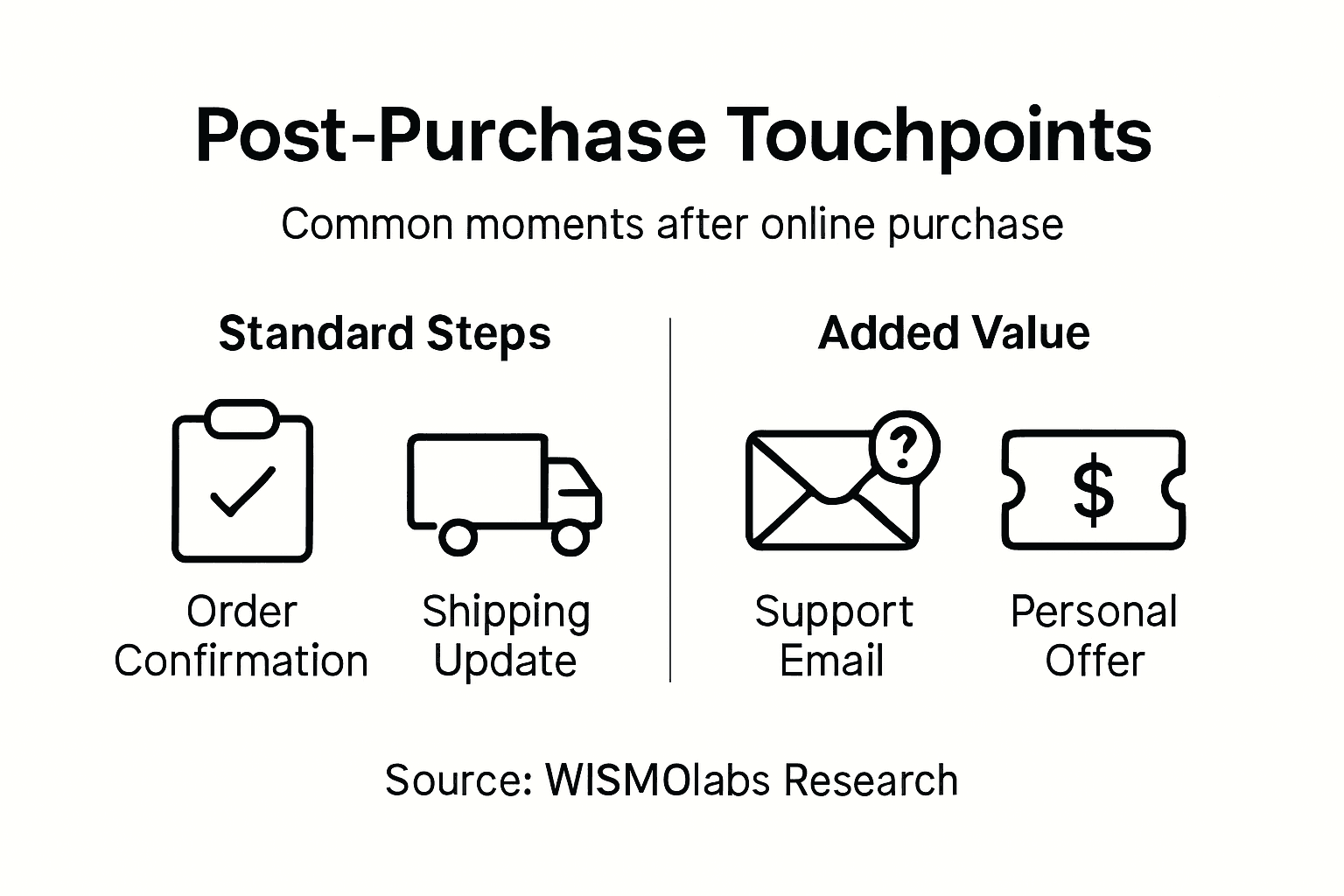
Traditional post-purchase touchpoints include six essential communication stages that guide customers through their post-purchase journey. These typically encompass order confirmation, dispatch notification, out-for-delivery updates, delivery confirmation, return and refund communications, and post-delivery follow-ups. Each touchpoint serves a unique purpose in maintaining transparency, reducing customer anxiety, and demonstrating the brand’s commitment to exceptional service.
Beyond standard transactional communications, advanced post-purchase touchpoints now integrate personalized experiences that add genuine value. These might include product usage tips, complementary product recommendations, exclusive loyalty rewards, or personalized feedback requests. By transforming routine communications into meaningful interactions, brands can convert a simple transaction into an opportunity for deeper customer connection and potential future sales.
Here’s a summary of traditional vs. advanced post-purchase touchpoints:
| Touchpoint Type | Description | Customer Benefit |
|---|---|---|
| Order Confirmation | Transaction receipt and order details | Assurance and transparency |
| Dispatch Notification | Notification of shipping progress | Reduces customer anxiety |
| Delivery Updates | Out-for-delivery and delivery confirmation | Real-time status awareness |
| Return & Refund | Policies and instructions | Builds trust and confidence |
| Personalized Tips | Usage advice or product guidance | Enhances product satisfaction |
| Loyalty Rewards | Offers exclusive rewards or perks | Boosts repeat purchase rates |
| Feedback Requests | Solicits opinions and suggestions | Fosters brand relationship |
Pro Tip: Design your post-purchase touchpoints as a cohesive narrative that provides consistent, helpful information while subtly reinforcing your brand’s unique value proposition.
How AI Optimizes Engagement Strategies
Artificial Intelligence is transforming post-purchase engagement by enabling unprecedented levels of personalization and predictive communication. By analyzing vast amounts of customer data, AI systems can now anticipate customer needs, preferences, and potential pain points with remarkable accuracy, creating more meaningful and responsive interactions throughout the customer journey.

AI technologies are particularly powerful in crafting personalized post-purchase communication that feels genuinely tailored to individual customers. These intelligent systems can dynamically generate context-aware messages, recommend relevant products, and proactively address potential concerns before they escalate. Machine learning algorithms continuously refine communication strategies by analyzing customer responses, engagement metrics, and behavioral patterns.
The most advanced AI engagement strategies go beyond simple automation, creating adaptive experiences that evolve with each customer interaction. By integrating real-time contextual data, predictive analytics, and natural language processing, these systems can generate emotionally intelligent communications that feel personal and immediate. This approach transforms traditional transactional interactions into meaningful dialogues that build long-term customer trust and loyalty.
Pro Tip: Implement AI-driven engagement tools that can learn and adapt from each customer interaction, creating increasingly sophisticated and personalized communication strategies over time.
Peak Engagement Window and Strategic Timing
The post-purchase period represents a critical moment of heightened customer attention and emotional investment. Immediately after completing a transaction, customers are most receptive to brand messaging, creating a unique opportunity for strategic engagement that can dramatically influence long-term loyalty and potential repeat purchases.
Customer anxiety and satisfaction peaks during the initial post-purchase phase, making it the most strategic window for meaningful communication. This short but powerful timeframe allows brands to reinforce positive purchase emotions, provide reassurance, and proactively address potential concerns before they transform into negative perceptions. By understanding and leveraging this psychological window, companies can transform a single transaction into the foundation of an ongoing customer relationship.
Successful strategic timing involves more than just sending automated messages. The most effective post-purchase engagement strategies use intelligent, contextually aware communications that feel personalized and genuinely helpful. This means delivering precisely timed updates, usage tips, complementary product recommendations, and support resources that align with the customer’s immediate needs and emotional state. Advanced brands are now using predictive analytics and machine learning to determine the optimal moment and content for each individual customer interaction.
Pro Tip: Create a dynamic communication sequence that adapts its timing, frequency, and content based on individual customer behavior and engagement signals.
Business Impact: Retention, Reputation, Revenue
Post-purchase engagement represents a critical strategic lever for modern ecommerce businesses, directly influencing three fundamental business metrics: customer retention, brand reputation, and overall revenue generation. By transforming transactional interactions into meaningful relationships, companies can create sustainable competitive advantages in increasingly crowded digital marketplaces.
Post-purchase engagement strategies profoundly impact business performance by creating deep emotional connections with customers. Loyal customers contribute significantly more to long-term revenue, with studies showing that repeat purchasers can generate up to 67% more value compared to one-time buyers. This approach goes beyond traditional sales tactics, focusing on building trust, providing exceptional experiences, and demonstrating genuine commitment to customer satisfaction.
The financial implications of effective post-purchase engagement are substantial. By implementing personalized communication, transparent processes, and proactive support, businesses can dramatically reduce customer churn, increase repeat purchase rates, and generate positive word-of-mouth marketing. Advanced strategies that leverage data-driven insights and intelligent communication technologies can transform a single transaction into a long-term, mutually beneficial relationship that continues to generate revenue well beyond the initial sale.
The following table highlights key business outcomes of post-purchase engagement:
| Outcome | How Engagement Contributes | Example Impact |
|---|---|---|
| Customer Retention | Fosters loyalty through follow-up | Higher repeat sales rate |
| Brand Reputation | Transparent communication builds trust | More positive reviews |
| Revenue Generation | Upsell and cross-sell opportunities | Increased purchase value |
Pro Tip: Develop a comprehensive post-purchase engagement framework that tracks customer interaction quality, sentiment, and potential upsell opportunities across multiple touchpoints.
Key Mistakes and What to Avoid
Post-purchase engagement requires strategic precision, and many businesses inadvertently undermine their customer relationships through seemingly minor communication missteps. Understanding these potential pitfalls is crucial for maintaining a positive brand reputation and ensuring long-term customer loyalty across digital commerce platforms.
Critical post-purchase communication mistakes can derail customer experiences by creating unnecessary friction and frustration. The most common errors include inconsistent messaging, lack of transparency in shipping and delivery processes, inadequate customer support responsiveness, and failure to personalize follow-up communications. These mistakes not only increase customer anxiety but also significantly reduce the likelihood of repeat purchases and positive word-of-mouth recommendations.
Effective post-purchase engagement demands a holistic approach that anticipates and proactively addresses potential customer concerns. This means developing robust communication protocols, implementing intelligent tracking systems, creating flexible return policies, and training support teams to provide empathetic, solution-oriented responses. Businesses must move beyond transactional interactions and view each customer touchpoint as an opportunity to build trust, demonstrate value, and reinforce the brand’s commitment to customer satisfaction.
Pro Tip: Conduct regular audits of your post-purchase communication channels, mapping out potential friction points and developing contingency strategies to address customer concerns before they escalate.
Unlock the Power of Strategic Post-Purchase Engagement with WISMOlabs
The article highlights the critical challenge ecommerce brands face in transforming post-purchase communication from simple transactional updates into meaningful, personalized experiences that build loyalty and drive revenue. Key pain points include customer anxiety from redundant notifications, missed opportunities during the Peak Engagement Window, and the difficulty of delivering context-aware messaging that feels genuinely tailored. WISMOlabs addresses these exact challenges by treating the post-purchase journey as a sophisticated Decision Layer rather than a reactive process.
With WISMOlabs’s intelligent orchestration platform, retailers can deliver proactive, high-value branded updates timed perfectly within the Peak Engagement Window™ to reduce “Where Is My Order?” (WISMO) tickets and negative reviews. Powered by proprietary AI technology, WISMOlabs sifts through unstructured carrier data to provide hyper-accurate ETAs and uses Reputation Guard logic to protect brand reputation by holding back review requests when delivery issues arise. This creates an emotionally reassuring, consistent experience that turns every customer touchpoint into a growth opportunity through personalized upsells and cross-sells.
Ready to move beyond basic notifications and build lasting customer relationships that boost retention, reputation, and revenue? See how WISMOlabs transforms post-purchase engagement into a strategic advantage.
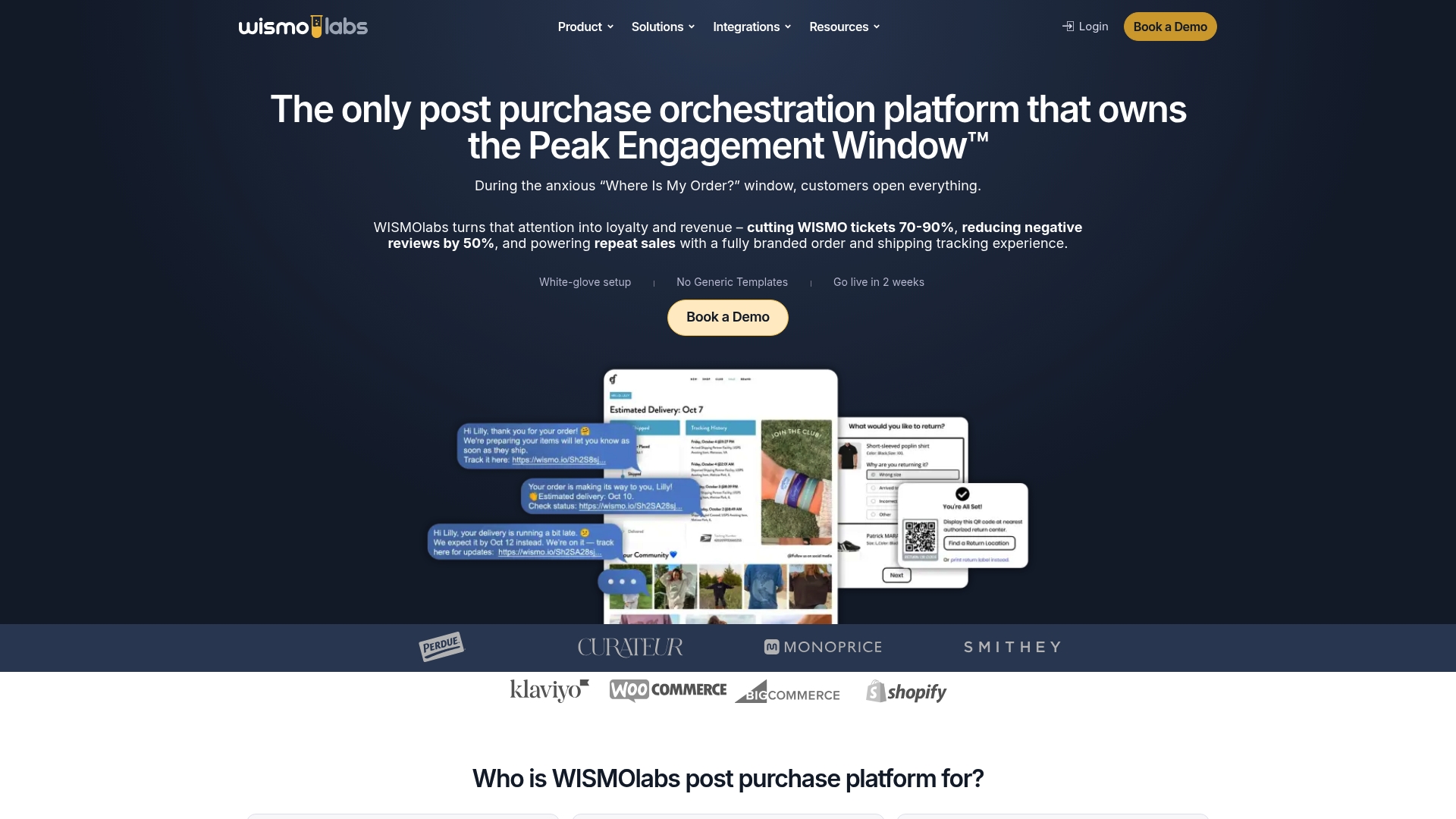
Explore our platform today and start capitalizing on the Peak Engagement Window™ with intelligent, data-driven communication that truly speaks to your customers at the right time. Visit WISMOlabs to learn more and request a demo now.
Frequently Asked Questions
What is post-purchase engagement in ecommerce?
Post-purchase engagement refers to the strategies and interactions that ecommerce brands implement after a customer has made a purchase. It focuses on enhancing customer experiences, building relationships, and encouraging repeat business beyond the initial transaction.
Why is post-purchase engagement important for businesses?
Post-purchase engagement is crucial because it can significantly impact customer retention, brand reputation, and revenue generation. Engaging customers after their purchase builds trust and increases the likelihood of repeat purchases, ultimately leading to greater long-term value.
What are some effective post-purchase touchpoints?
Effective post-purchase touchpoints include order confirmations, shipping notifications, delivery updates, return and refund communications, and post-delivery follow-ups. Advanced strategies also incorporate personalized tips, loyalty rewards, and feedback requests to strengthen customer relationships.
How can artificial intelligence enhance post-purchase engagement strategies?
Artificial intelligence can enhance post-purchase engagement by analyzing customer data to predict needs and preferences. AI-driven tools can create personalized communications, recommend relevant products, and proactively address customer concerns, leading to more meaningful interactions.